
In order to reduce unnecessary administration and rework, an organized denial management system improves effectiveness. According to data from the industry If denials are not efficiently handled, they could constitute 5-10% of claims revenue. With a thorough follow-up and expert study, we can close the gap between claims that are rejected and reclaimed revenue, turning potential losses into realized profits.

Maintaining a steady cash flow and minimizing revenue loss require efficient denial management. We can stop repeated problems in draining the Revenue of your practice by identifying and resolving the exact reasons that Insurance deny claims. Our proactive approach helps ensure that your practice is able to maintain its financial stability by ensuring strict adhering to the policies of payers codes, standards for coding, and the regulatory requirements.
A structured denial management strategy improves practice efficiency by reducing unnecessary rework and administrative burdens. Industry data shows that denials can account for 5–10% of total claim revenue if not properly managed. By ensuring that we follow up on our work and conduct professional analysis, we bridge the gap between claims rejected and realised revenue, turning potential losses into real-time income.
of claim revenue
at risk annually
Our area of expertise is the systematic detection of settlement, and the avoidance of denied claims. Our strategy is to recuperate every penny while increasing the standard of any subsequent contributions.

To ensure that no money goes missing, we identify and track every Denied claim.

Our expert team conducts a comprehensive Root Cause Analysis to identify and resolve the underlying issues whether in eligibility, coding, or documentation that lead to claim denials.

The team creates and files appeals, which include all the necessary clinical and administrative documentation.

We remain vigilant about monitoring the claims until all revenue is recovered.

For transparent reporting and auditing every step of the process of denial is documented.

To correct issues with the system and increase the quality of claims We collaborate across teams.
The revenue stream you generate is constructed on solid foundations because of a robust method of managing denials. We assure you that your Practice is able to achieve maximum financial results by proactively addressing denials and preventing them from recurring.
Important Advantages Include:
We monitor our Denial Management services with specific KPIs that indicate accuracy, persistence, and financial impact.
Measures the percentage of claims denied by payers, reflecting our focus on high-quality initial submissions.
Tracks the percentage of uncollectible revenue, ensuring it stays well below industry averages.
Measures the speed at which we identify and begin the resolution process for any denied claim.
Indicates our effectiveness in overturning payer denials and securing the reimbursement you deserve.
Measures our success in fixing root causes so the same mistakes don’t happen twice.
Our organization uses systematic reports to track its Denial Management performance. We establish thorough dashboards which display denial reasons and payer trends and appeal outcomes. Our monthly meetings with different departments enable us to identify root causes which we use to create solutions that help maintain low denial rate.
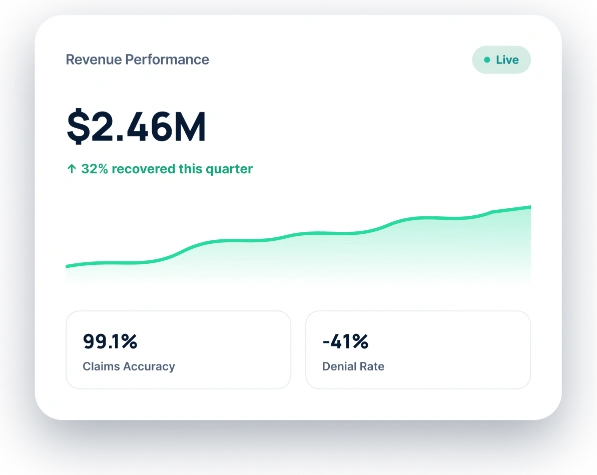
Recent studies indicate that up to 30% of denied claims are preventable. Practices that implement structured denial management report a 20–25% reduction in recurring denials and significantly faster recovery cycles. Proactive denial handling is now a recognized best practice for revenue cycle optimization.
Our Free Practice Audit & Resolution Review uncovers hidden gaps in your current denial handling. We conduct a thorough examination of your denial patterns and provide specific procedures to enhance your operational efficiency and recovery rate.
Accurate and persistent denial management leads to measurable performance improvements. Your practice will experience fewer rejections, quicker payment processing, and a significant decrease in financial write-offs. We make your financial results increasingly predictable.
Our Claims Scrubbing services are created to protect your revenue and ensure that your claims are “payer-ready” the moment they are sent.

We manage every denial with precision and a commitment to full recovery.

We identify and fix submission risks before they impact your collection patterns.

Our processes integrate with your current systems to reduce operational discontinuity.

We work to achieve stable cash flow patterns while decreasing the administrative tasks you need to handle.
Everything you need to know before making a decision — clear answers to common questions.
A denial happens after the payer has processed the claim and chosen not to pay, whereas a rejection occurs at the front end (clearinghouse) owing to data issues.
To ascertain whether the problem is related to eligibility, coding, or medical necessity, we examine the Payer’s Remark Codes (RARC) and Reason Codes (CARC).
These are denials brought on by straightforward mistakes like inaccurate patient information, missing modifiers, or expired eligibility all of which we can prevent
After receiving the denial notification, our KPI is to start the resolution process and file appeals within 72 hours.
Indeed, we work with clinicians to collect the medical records required for clinical appeals pertaining to medical necessity
The industry benchmark is usually below 5–7%; our goal is to keep it below 6%.
We use specialized dashboards that track every appeal’s status, payer responses, and final resolution dates.
Absolutely. By successfully appealing denials, we turn potential “Bad Debt” into actual revenue.
We perform monthly root-cause analysis and update your “front-end” scrubbing rules to catch those specific errors before submission.
We use both. We utilize payer portals for quick updates and direct phone calls for complex appeals that require human intervention.
From strategic payer mapping to the day your active provider ID lands, we run the whole runway.


We offer top-tier solutions tailored for the healthcare industry across the United States. With a focus on efficiency and precision, our team is dedicated to delivering outstanding results.
© Copyright 2026 | All Rights Reserved Elint RCM